Why Jumping Between 10 Deal Sites Is Costing You Time (and Sometimes Money)
May 2, 2026
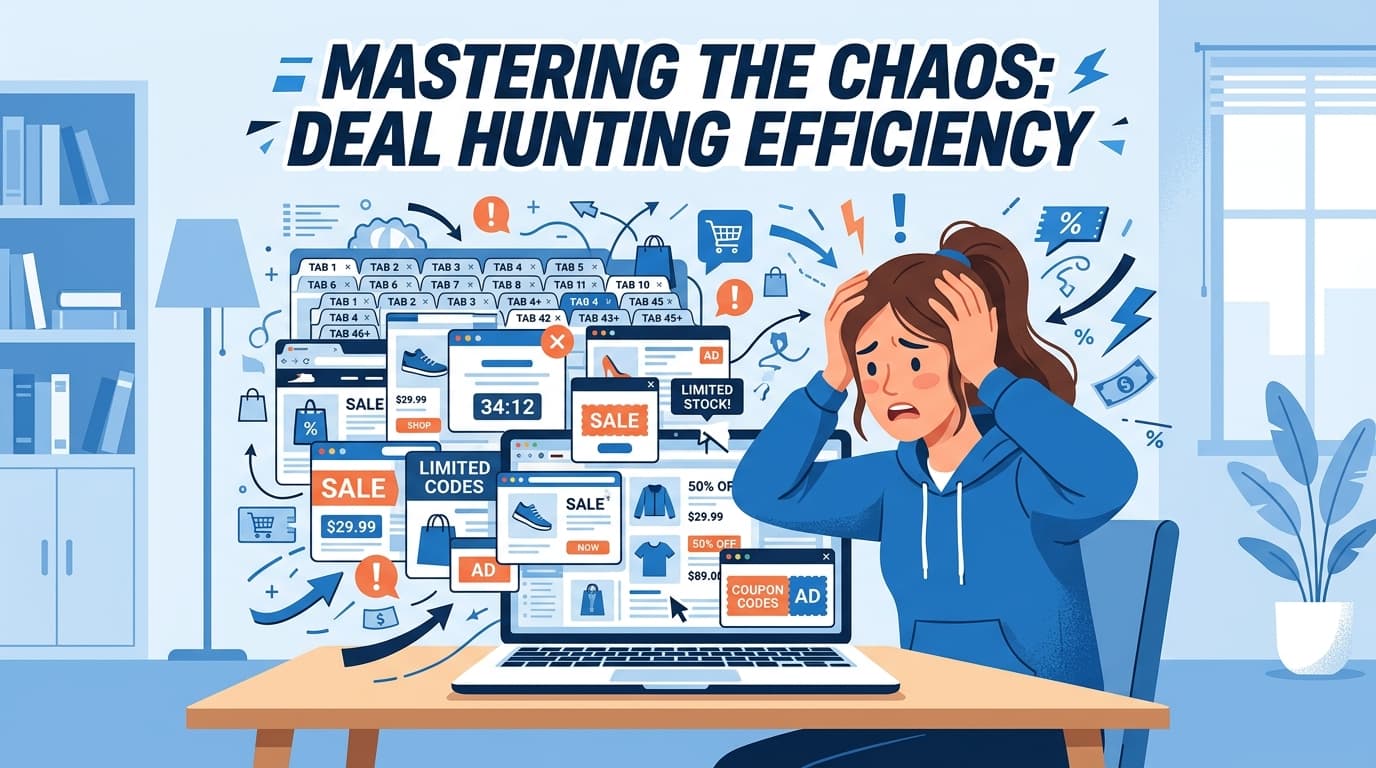
You've been there. You find something you want to buy, and instead of just buying it, you open eight tabs.
RetailMeNot. Honey. SlickDeals. Rakuten. Google Shopping. The store's own site. A Reddit thread from 2024 that might still be relevant. A coupon site that looks like it was designed in 2009 but somehow still ranks on Google.
Forty-five minutes later, you've saved $3.50 and you're not even sure you wanted the thing anymore.
The Time Math Doesn't Work
Here's the problem nobody talks about: your time has a value.
If you spend 30 minutes hunting for a deal on a $50 item and find 15% off, you saved $7.50. That's $15/hour for your effort — below minimum wage in most places, and that's before you account for the mental energy of holding all those tabs open, comparing slightly different prices, and decoding which "deal" is actually current.
For small purchases, the hunt almost never pencils out. For bigger ones, it can — but only if you're efficient about it.
Decision Fatigue Is Real, and Deal Sites Cause It
Every tab you open adds a choice. Is this site trustworthy? Is this coupon expired? Is the "original price" they're crossing out real? Is free shipping factored in?
By the time you've been through five deal sites, your decision-making is degraded. You're more likely to either give up entirely, buy something you're less sure about, or — ironically — pay more because you're too tired to keep comparing.
This is decision fatigue, and the multi-tab approach manufactures it at scale.
Flash Sales Don't Wait for You
Here's the one that actually costs money: flash deals and lightning sales expire while you're tabbing around.
A limited-time discount on Amazon, a flash sale on a brand's own site, a deal that's good for the next two hours — these don't pause while you check four other sites to make sure you're getting the best price. By the time you've confirmed it's a good deal, it's sometimes gone.
Speed matters more than most deal hunters admit.
The Aggregator Advantage
A deal aggregator solves the tab problem by doing the multi-site check before you even show up.
Instead of you bouncing between sources, the aggregator pulls deals from across the web, normalizes them, and surfaces the ones worth seeing. You get one clean interface instead of ten inconsistent ones. You skip the expired coupons, the fake "original prices," and the sites that are technically listing a deal from three months ago.
The time you save isn't just convenience — it's decision quality. When you're not exhausted from comparison shopping, you make better calls about what's actually worth buying.
One Tab Is Usually Enough
The irony of deal hunting is that the behavior that feels most frugal — the exhaustive multi-site search — is often the least efficient version of saving money.
Spending 45 minutes to save $4 isn't frugal. It's expensive in a different currency.
The better approach: one trusted source, pre-aggregated, with the noise already filtered out. Check it, decide, move on. The deals are there. You don't have to go looking for them everywhere.
That's what Dealery is built for — not to be another tab in the hunt, but to be the only one you need.